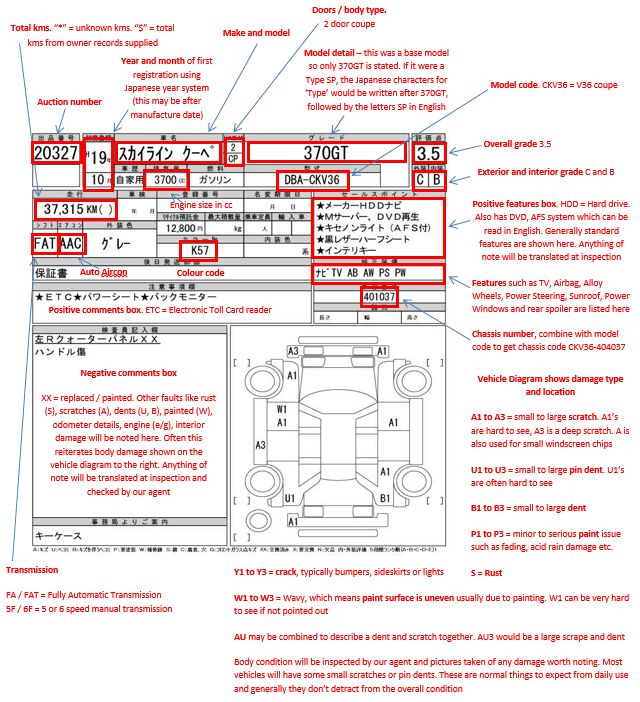
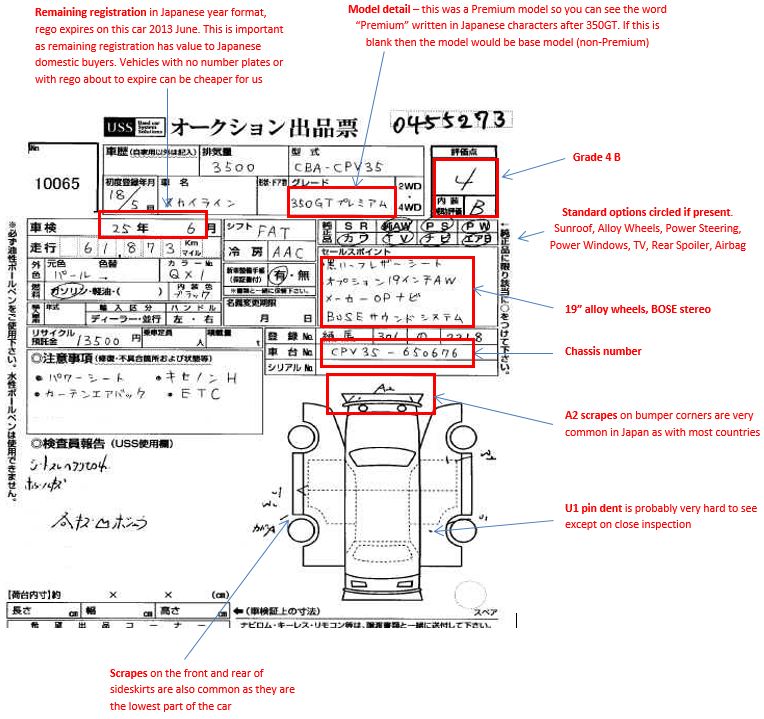
How to read a Japanese auction sheet
The grade, the letters, the panel diagram and the inspector's notes, explained field by field so you can judge a car before you bid on it.
Updated 3 September 2026
1. What an auction sheet is
Every car sold through a Japanese auction house is inspected before it goes under the hammer. The seller consigns it with its identity, mileage, paperwork and sales points on a single page. The auction house's inspector, who does not work for the seller, then adds what they find: an overall grade, a letter each for the interior and exterior, a panel diagram marked with damage codes, and free-text notes. That page is the auction sheet, 出品票 in Japanese.
The whole trade prices from it. Bidders abroad cannot see the car before the sale, so the sheet is the evidence they bid on, and it is the document your advisor translates for you before any bid goes in. Learning to read one yourself means you can judge a shortlist before asking, and spot the cars that deserve a closer look.
Two things to hold onto. The sheet is written in Japanese shorthand, so most of the work is vocabulary, and this guide ends with a glossary of the terms inspectors actually write. And the sheet is honest but not complete: an inspector has minutes with each car, so the grade and the notes tell you where to look, not whether to buy.
2. The anatomy of a sheet
The sheet below is redrawn, cell for cell, from a real USS sheet: the one photographed under it, for a car we bought for a customer. Every field sits where the form prints it, with the same values, numbered in the order you read them. The lot number and chassis serial are blanked on both.
-
1
Lot number. How the car is referenced at that sale. Blanked here and on the photograph.
-
2
Model code and engine size. 型式 fixes the exact variant. DBA-RB3 is a Honda Odyssey, though the make is not printed anywhere on the sheet.
-
3
Use history. 自家用 private, レンタ rental, 事業用 commercial. One is circled. A rental or fleet car has had many drivers.
-
4
The overall grade. Top right, and the first thing to find. 3.5 here.
-
5
First registration. Year and month in the Japanese era, often with no era letter. 24/8 is Heisei 24, August 2012. The conversion is in the mileage and year section.
-
6
Model, doors and trim. オデッセイ, 5W for a five-door wagon, Mエアロパッケージ for the trim. 2WD or 4WD sits beside it to be circled; neither is on this sheet.
-
7
Exterior and interior letters. A to D, under the grade. USS prints 外装 first; the label above each letter says which.
-
8
Shaken. The roadworthiness certificate expiry. Blank, as here, means it has lapsed, which is normal for a car being sold on.
-
9
Mileage. 180,803 km, with the unit ticked beside it. A lot for a Japanese car of this age, and it shows in the letters.
-
10
Sales points. Written by the seller, not the inspector. Six here: one owner, factory navigation with a reversing camera, leather, smart key, a flip-down monitor and factory alloys.
-
11
Factory equipment. A printed list from the seller; circled means fitted. Power steering, power windows, alloys, airbag, ABS and navigation are marked, sunroof and TV are not.
-
12
Chassis number. Blanked here. On the original it identifies the individual car, and it is how a sheet is matched to the car that arrives.
-
13
The cabin checklist. Printed condition words for the cabin, the seats and the audio; the inspector circles what applies. Here 汚れ, soiling, and スレ, seat scuffing.
-
14
Inspector's notes. Four handwritten lines, walked through in the notes section. The pillar line is the one that matters.
-
15
The panel diagram. Every mark by position, front at the top. The XX at the back of the left rear door and the two W2 on that side are this car's story.
Where to look first
- 1. The grade, top right, and the two letters under it.
- 2. The diagram, bottom right: the XX at the back of the left rear door and the two W2 on the same side.
- 3. The inspector's box, bottom left, which the notes section walks through line by line.
Find the label, not the position
Other houses print the same fields in different places. The labels are what to look for, so here is every one on the form, in the order it appears.
| Label | Reads as | What it is |
|---|---|---|
| Label 出品番号 | Reads as shuppin bangō | What it is Lot number. How the car is referenced at that sale. |
| Label 型式 | Reads as katashiki | What it is Model code, for example DBA-RB3. It fixes the exact variant. The make is not always printed, and the code is how the trade knows an RB3 is an Odyssey. |
| Label 排気量 | Reads as haikiryō | What it is Engine capacity, in cc. |
| Label 車歴 | Reads as shareki | What it is Use history: 自家用 private, レンタ rental, 事業用 commercial. One is circled. |
| Label 評価点 | Reads as hyōka-ten | What it is The overall grade. S and 6 down to 1, or R and RA. |
| Label 初年度登録 | Reads as shonendo tōroku | What it is First registration, year and month in the era. Also printed as 年式 or 初度登録. |
| Label 車名 | Reads as shamei | What it is Model name, usually without the make. |
| Label ドア形状 | Reads as doa keijō | What it is Door count and body shape. 5W on the sample, read as a five-door wagon. |
| Label グレード | Reads as gurēdo | What it is Trim level. The model grade, not the condition grade. |
| Label 外装 · 内装 | Reads as gaisō, naisō | What it is Exterior and interior letters, A to D. The label above each letter says which is which. |
| Label 車検 | Reads as shaken | What it is Roadworthiness certificate expiry. Blank, 無 or 切れ means it has lapsed. |
| Label 燃料 | Reads as nenryō | What it is Fuel: G petrol, D diesel, ハイブリッド hybrid. |
| Label 定員 · 積載量 | Reads as teiin, sekisairyō | What it is Seats and load capacity. Load is for commercial vehicles. |
| Label 走行 | Reads as sōkō | What it is Mileage, with a マイル or Km tick beside it. Also printed as 走行距離. |
| Label フロア · コラム · ダッシュ | Reads as furoa, koramu, dasshu | What it is Where the shifter sits, then AT or MT. Some houses print シフト instead. |
| Label 外装色 · カラーNo. · 内装色 | Reads as gaisō-shoku, karā nanbā, naisō-shoku | What it is Exterior colour, the maker's paint code, interior colour. |
| Label 冷房 | Reads as reibō | What it is Air conditioning. AAC is automatic climate control. |
| Label セールスポイント | Reads as sērusu pointo | What it is Sales points. Written by the seller, not the inspector. |
| Label 登録番号 | Reads as tōroku bangō | What it is Registration plate. Usually blank on a copy. |
| Label 純正装備品 | Reads as junsei sōbihin | What it is Factory equipment, from the seller's entry. Circled means fitted. |
| Label 名変期限 | Reads as meihen kigen | What it is Deadline for the ownership transfer after the sale. A domestic matter. |
| Label 新車保証書 · 保証書 · 取扱説明書 | Reads as shinsha hoshō-sho, hoshō-sho, torisetsu | What it is New-car warranty, warranty booklet and owner's manual, each ticked if present. |
| Label 車台番号 | Reads as shadai bangō | What it is Chassis number. |
| Label 輸入車 | Reads as yunyū-sha | What it is For imported cars only: Western year, dealer or parallel import, left or right-hand drive, serial. |
| Label リサイクル預託済金額 | Reads as risaikuru yotaku-zumi kingaku | What it is The recycling fee deposited in Japan, in yen. Refundable when the car is exported. |
| Label 出品店記入 | Reads as shuppin-ten kinyū | What it is The seller's box. Also printed as 注意事項欄. |
| Label 検査員記入 | Reads as kensa-in kinyū | What it is The inspector's box. Also printed as 検査員報告 or 備考. |
| Label ホイール · ドアミラー · 小キズ · 小ヘコミ | Reads as hoīru, doa mirā, ko-kizu, ko-hekomi | What it is Under the diagram: wheels, door mirrors, small scratches, small dents, each with a tick and 有 for yes. |
| Label コーナー | Reads as kōnā | What it is The lane the car is sold in at that house. |
3. The overall grade, S and 6 down to 1
The grade sums up the car's condition in one figure. The inspector sets it and the seller cannot influence it. Half points exist, so a 4.5 sits between a 4 and a 5. Two things pull a grade down, bodywork wear and accident repair, and once repair history is involved the letters R and RA replace the number entirely.
| Grade | What it means | How to read it |
|---|---|---|
| Grade S, 6 | What it means New or nearly new, with very low mileage. | How to read it Rare at auction. Expect showroom condition. |
| Grade 5 | What it means Excellent. Only faint marks the inspector had to look for. | How to read it Typically low mileage and carefully kept. |
| Grade 4.5 | What it means Very clean. A few small scratches or a light dent at most. | How to read it A strong buy for most importers. |
| Grade 4 | What it means Good. Several minor scratches or small dents, nothing that needs bodywork to enjoy the car. | How to read it Our usual minimum. See how Carimport reads a sheet, below. |
| Grade 3.5 | What it means Fair. Visible scratches, dents or a refinished panel, and more cabin wear. Sometimes a light repair the house graded on condition. | How to read it Worth it only when the notes are specific and the price reflects them. |
| Grade 3 | What it means Rough. Several panels need attention, paint may be faded or peeling. | How to read it Priced for restoration, not daily use. |
| Grade 2 | What it means Poor. Serious body damage, heavy rust or signs of flooding. | How to read it Avoid. |
| Grade 1 | What it means Modified, or with major mechanical changes, whatever the bodywork. | How to read it Judge it case by case. The number says little about condition. |
| Grade R, RA | What it means Accident-repaired. R for a repair the inspector considers significant, RA for a lighter one. | How to read it Not a condition grade at all. Repair history, below, explains. |
| Grade 0, A | What it means Repair history, at the houses that write a number or a letter in place of R. | How to read it Read it as an R. The notes name the panels. |
| Grade *** | What it means Not graded. A car the inspector would not grade, such as one that does not run, or one sold as is. | How to read it Treat the condition as unknown. |
A grade is only comparable within the same auction house, and only against a car of similar age. Inspectors grade against what is reasonable for the age, so a 4 on a two-year-old car and a 4 on a twelve-year-old car describe different things. The house-to-house difference has its own section below.
4. Interior and exterior letters, A to D
Next to the number, most sheets carry one or two letters. USS gives both an interior and an exterior letter; some houses give only the interior. Both use the same scale, read as below. Each house writes its own definitions, so treat the wording as a guide rather than a rule.
| Letter | Interior | Exterior |
|---|---|---|
| Letter A | Interior As new. No wear, no marks, no smell. | Exterior Paint and trim as delivered, nothing to code. |
| Letter B | Interior Clean. Light wear consistent with age, nothing that needs fixing. | Exterior Small scratches or a light dent the inspector still coded. |
| Letter C | Interior Average for its age. Worn bolsters, marks on the dash or trim, perhaps a small burn or stain. | Exterior Several coded marks, or a dent that needs a body shop. |
| Letter D | Interior Below average. Tears, burns, heavy staining, odour or missing parts. | Exterior Significant marks, a refinished panel or worse. |
The interior letter deserves more attention than most buyers give it. Bodywork can be priced from the diagram. A cabin that has been smoked in or left to fade cannot, and only the notes will say which, so a C interior is a reason to read the notes box twice.
5. The panel diagram and damage codes
The diagram is a top-down outline of the car. On each panel the inspector writes a letter for the type of mark and a number for its size. The letter says what, the number says how much, and the position says where.
Reading this diagram
- A1 on the front bumper and bonnet. Fine scratches and small stone chips. Polish and touch-up.
- W1 on the left front wing. The panel has been refinished. A bolt-on wing, so bodywork, not repair history.
- U1 and U2, A2 on the right doors. A small dent on the front door; a larger one with a scratch through the paint on the rear. The body-shop item on this car.
- G1 on the windscreen, E1 on the roof. A pinhead chip and a dimple. Neither is worth pricing.
- S1 on the right rear quarter. A spot of surface rust on an edge. Worth a look at the sale.
- Y1 on the rear bumper. A small crack in the plastic.
- XX on the left rear quarter. A replaced welded panel. With this on the diagram the car is an RA whatever the other codes say, and the notes will describe the repair.
| Code | Meaning | Reading the number |
|---|---|---|
| Code A | Meaning Scratch (キズ). | Reading the number A1 is a fine mark that polishes out. A2 has gone through the top coat. A3 needs paint. |
| Code U | Meaning Dent (へこみ). | Reading the number U1 is a fingertip-sized carpark dent. U2 is obvious. U3 needs a body shop. |
| Code B | Meaning Dent with a scratch. | Reading the number The U scale, with paint damage as well. Some houses use B for a larger dent. |
| Code W | Meaning Wave, a repair mark. | Reading the number Paint that is not factory-smooth, so the panel has been refinished. W1 is hard to see; W3 shows from a few steps back. |
| Code S | Meaning Rust (サビ). | Reading the number Surface rust. S1 is a spot on an edge; S3 is spreading. |
| Code C | Meaning Corrosion (腐食). | Reading the number Rust that has eaten into the metal. C2 or higher on a sill or wheel arch is a snow-region tell. |
| Code P | Meaning Paint fault. | Reading the number Fading, peeling or a poor respray. The number grows with the area. |
| Code Y | Meaning Crack or tear. | Reading the number Bumpers, lamps and plastic trim. The number grows with the length. |
| Code X | Meaning Needs replacing. | Reading the number Damaged beyond economic repair. |
| Code XX | Meaning Replaced. | Reading the number The panel has already been changed. On a structural panel this is repair history, not bodywork. |
| Code G | Meaning Stone chip in glass. | Reading the number Usually the windscreen. G1 is a pinhead mark; larger chips are written in the notes. |
| Code E | Meaning Dimple (エクボ). | Reading the number A very small dent, often hail or a door edge. Rarely worth pricing. |
Severity runs from 1 to 3 on most sheets; a few houses use 4. Together with the position, the codes are what your advisor turns into a bodywork estimate before bidding, which is the realistic way to compare a 4 with two A2 marks against a 4.5 with a W1 on the bonnet.
6. Repair history: R, RA and what XX means
Japanese auction houses draw a firm line between damage and repair history. A scratched grade 4 is still a grade 4. A car that has had a structural panel repaired or replaced after an accident is no longer graded on condition at all: it becomes an R or an RA, and the notes describe the repair.
Structural means the frame and the panels welded to it: the radiator core support, the inner wings and side members, the pillars, the floor and the rear panel. A replaced door or bolt-on wing is bodywork, not repair history, which is why an XX on a door is a smaller matter than an XX on a rear panel.
- R: repair history the inspector considers significant. The notes name the panels.
- RA: repair history that is light or well executed, often a single panel. The car may drive and look like a grade 4, but it is priced as an RA at its next sale.
- 修復歴有 (shūfukureki ari) in the notes means the same thing in words. 修復歴無 means none is declared.
- XX on the diagram marks a replaced panel. Look at where it sits before deciding what it means.
We do not bid on R or RA cars for customers. The saving at the hammer looks tempting, but the history follows the car to its next sale in Malaysia, and the quality of the repair behind it cannot be judged from the sheet.
Ready to try it on a real car?
Price any auction car on the road in 30 seconds.
7. Equipment and option codes
The equipment line lists what the car has in a handful of letters. They are much the same across auction houses, and on the USS form they are the seller's entry, like the sales points: they say the car has navigation, not that it works. A fault is the inspector's to record, and it appears in the notes box instead, as AC不良 for a faulty air conditioner.
| Code | Equipment | Worth knowing |
|---|---|---|
| Code SR | Equipment Sunroof (サンルーフ). | Worth knowing Some sheets include panoramic glass roofs. |
| Code AW | Equipment Alloy wheels (アルミ). | Worth knowing 純正 means factory alloys; 社外 means aftermarket. |
| Code PS | Equipment Power steering. | Worth knowing Standard on nearly everything, so its absence is the information. |
| Code PW | Equipment Power windows. | Worth knowing FのみPW means front only. |
| Code AB | Equipment Airbag. | Worth knowing The count is sometimes written, as AB2. |
| Code TV | Equipment Television. | Worth knowing Usually built into the navigation unit. |
| Code ナビ | Equipment Navigation (カーナビ). | Worth knowing 純正ナビ is the factory unit, with Japanese maps only. |
| Code 革 | Equipment Leather (かわ). | Worth knowing 本革 is genuine leather; 革調 is leather-look. |
| Code ETC | Equipment Toll transponder. | Worth knowing Japan only. No use in Malaysia. |
| Code ABS | Equipment Anti-lock brakes. | |
| Code AAC | Equipment Automatic climate control. | Worth knowing A/C alone is manual air conditioning. |
| Code 4WD, ターボ | Equipment Four-wheel drive, turbo. | Worth knowing Printed with the grade name on some layouts. |
8. Mileage, shaken and the model year
Three fields on the sheet are misread more often than the grade.
Mileage
Mileage is in kilometres, read from the odometer on the day. A star beside the figure, or メーター交換車 in the notes, means the odometer was replaced and the true mileage is higher than shown. 走行不明 means the mileage cannot be verified at all and the car is sold on that basis. Japanese cars tend to cover few kilometres a year, so a low figure is common rather than suspicious, and the service record book, 記録簿, is how it is confirmed.
Shaken
車検 is Japan's roadworthiness certificate, due at three years and then every two. The sheet gives its expiry; blank, 無 or 切れ means it has lapsed. For a car being exported the expiry itself does not matter, because the car leaves Japan's system. The field is still worth reading: a car with a fresh shaken has just passed its mandatory inspection.
Model year
The year field, 初年度登録 on the USS form and 年式 on others, is the date of first registration in Japan, written in the imperial era: a number for the year within the era, and sometimes a letter for the era itself. Often only the number is printed. 24/8 on the sheet in the anatomy section is Heisei 24, August, so 2012. Convert it before you compare cars, and before you check it against Malaysia's import age rules.
| Letter | Era | Conversion | Example |
|---|---|---|---|
| Letter S | Era Showa | Conversion Add 1925 | Example S63 is 1988 |
| Letter H | Era Heisei | Conversion Add 1988 | Example 24 is 2012 |
| Letter R | Era Reiwa | Conversion Add 2018 | Example 5 is 2023 |
When no letter is printed, the number and the car together tell you the era. Heisei ran to 31 and ended in April 2019; Reiwa began in May 2019 and reached 8 in 2026. So 9 to 31 can only be Heisei, and 1 to 8 is Reiwa unless the car is plainly from the 1990s. Some houses now print the Western year as well. Where only the era appears, do the sum. It is the difference between a car that qualifies for an import permit and one that does not.
9. Reading the inspector's notes
The notes box is where the inspector writes what the diagram cannot show: mechanical faults, cabin condition, smells, missing items and anything about repairs. It is clipped Japanese, mostly katakana, with the same few hundred words recurring. Here is the box from the sheet in the anatomy section, line by line, then the diagram it sits beside and the seller's box above it.
| Note | Reads as | What it tells you |
|---|---|---|
| Note 外足廻り | Reads as soto ashi-mawari | What it tells you Aftermarket suspension. 外 on its own is the inspector's shorthand for 社外, non-factory, so the car sits on suspension parts the maker did not fit. The seller's list does not mention it, which is the point of reading both. |
| Note 左ロックピラー XX | Reads as hidari rokku pirā XX | What it tells you The left lock pillar has been replaced: the pillar the rear door latches onto, at the front edge of the rear quarter. A pillar's frame is structural and its outer skin is bodywork, and the house graded the car 3.5 rather than R, which says the inspector judged this replacement as bodywork, not repair history. It is still the mark that sends our buying agent to the car before any bid. |
| Note ハンドルスレ | Reads as handoru sure | What it tells you Steering wheel worn. Consistent with the mileage and the B interior. |
| Note ウスキズ | Reads as usu kizu | What it tells you Light scratches, said once for the car as a whole. The diagram carries the specifics. |
The diagram beside it
The XX sits at the back of the left rear door, where the door meets the quarter, and a W2 sits on the left rear quarter beside it: the panel next to the replaced pillar has been refinished. A second W2 at the front of the left side, where the wing meets the door, is the same kind of mark further forward. Read together, the marks point to one repair along the left side, and they are why the pillar line matters more than the grade. A and A1 on the bonnet, the roof, the rear doors, the right rear quarter, the boot and both bumpers are light scratches all round, the ordinary wear of a car at this mileage.
The seller's box
The sales points are the seller's list, not the inspector's: one owner, factory navigation with a reversing camera, leather seats, a smart key, a flip-down monitor and factory alloys. The equipment row is the seller's too, which is why ナビ and AW are circled there as well. The check that matters runs the other way, the inspector's lines against the seller's. Here the inspector found aftermarket suspension the seller did not list, and a replaced pillar no sales point would show. Read what the seller claims against what the inspector wrote.
Read together: a 3.5 that is honest about why. High mileage, a worn cabin, light scratches all round, non-factory suspension, and a repaired left side the house judged bodywork rather than repair history. The grade gives the price bracket. The diagram and the notes say what you are actually buying, and which question to ask before bidding.
10. Why the same grade differs between auction houses
Japan's auctions are run by several groups, each with its own inspectors and its own house standard. USS is the largest network, with Tokyo, Nagoya and Yokohama among the biggest single sales anywhere. TAA, HAA Kobe, JU, CAA, BAYAUC and ARAI make up most of the rest.
That is why a 4 at one house is not always a 4 at another. Some houses grade strictly, and their 4 would be a 4.5 elsewhere; others are known to be generous. Sheets also differ in whether they give both interior and exterior letters, and in how much the inspector writes.
Layouts move too. The USS form in the anatomy section puts the grade top right and the diagram bottom right, with the seller's and inspector's boxes beside it. Other houses move the diagram, set the letters beside the grade rather than under it, and mark the printed lists their own way. The field labels hardly change, which is why the anatomy section lists them. Find the label, not the position.
Rather than memorise the reputation of each house, compare within one. Two cars from the same sale were graded by the same team on the same day, and their sheets are directly comparable. Across houses, lean on the diagram and the notes, which describe the car rather than the standard.
Sale location matters for one more reason. Japan's snow regions salt their roads, and a car that has lived in Hokkaido or along the Sea of Japan coast carries underbody corrosion that no photograph shows. That is why C codes on sills and arches deserve a second look, and why 下廻りサビ, underbody rust, is a line we never skip.
11. How Carimport reads a sheet before bidding
We obsess over the sheet because it is the one moment in an import where a decision is cheap. After the hammer it is a shipped car. These are the rules we read by.
- We generally bid on grade 4 and higher. A lower grade can be right for a restoration or a rare car, and we will say so when it is, but it is the exception.
- We skip R and RA cars. Repair history follows the car to its next sale in Malaysia, and the quality of the repair cannot be judged from the sheet.
- Our buying agent inspects the car at the auction house before we bid. The sheet tells us where to look, the walk-around confirms it, and a car that does not match its sheet is dropped.
- We avoid snow-region auction houses such as Sapporo and Gunma, where salted roads leave the corrosion a diagram understates.
- We convert the year and price the coded marks before we set a maximum bid, so the bid already reflects the bodywork.
Every car on your shortlist comes with its sheet, translated, and your advisor walks you through it before the bid goes in. If you are researching on your own, you can buy the sheet for any car you are looking at.
12. Glossary of inspector's terms
The words inspectors actually write, grouped by where they appear on the sheet. Filter by Japanese, romaji or English. Where a term is common in both kanji and katakana, both are listed.
Reading the sheet
Abbreviations and the qualifiers that follow a term, on every sheet. The printed field labels are in the anatomy section.
| Japanese | Meaning | Worth knowing |
|---|---|---|
| ウス usu | Light, faint. | Also うす, 薄. ウスキズ: light scratches. |
| 出品票 shuppin-hyō | Auction sheet. | Literally the consignment slip. What this guide is about. |
| 出品者 shuppin-sha | Seller, consignor. | |
| 検査員 kensa-in | Inspector. | Employed by the auction house. |
| 記録簿 kirokubo | Service record book. | 有 present, 無 absent. |
| 取説 torisetsu | Owner's manual. | |
| 保証書 hoshō-sho | Warranty booklet. | |
| スペアキー supea kī | Spare key. | |
| 有 ari | Present, yes. | Follows an item: 記録簿有. |
| 無 nashi | Absent, none. | 修復歴無 is the line you want to see. |
| 要 yō | Required, needs. | 修理要 means needs repair. |
| 済 zumi | Done, completed. | クリーニング済 means cleaned. |
| 後日 gojitsu | To follow at a later date. | キーレス後日: the remote is sent after the sale. |
| 不明 fumei | Unknown. | 走行不明: mileage cannot be verified. |
| 現状 genjō | As is, in its present state. | A fault sold unrepaired. AT現状 means the gearbox is sold as it is. |
| 純正 junsei | Genuine, factory, OEM. | |
| 社外 shagai | Aftermarket, non-factory. | |
| 外 soto | Aftermarket, short for 社外. | On its own before a part: 外マフラー, 外足廻り. |
| 交換 kōkan | Replaced, exchanged. | メーター交換: odometer replaced. |
| 修理 shūri | Repair, repaired. | |
| 修復歴 shūfuku-reki | Accident-repair history. | The term behind R and RA. |
| 右 migi | Right. | |
| 左 hidari | Left. | |
| 前 mae | Front. | Also written F. |
| 後 ushiro | Rear. | Also written R. |
| 下 shita | Under, lower. | |
| 大 dai | Large, heavy. | キズ大: large scratches. |
| 小 shō | Small, light. | キズ小: small scratches. |
| 多 ta | Many, numerous. | キズ多: many scratches. |
| 穴 ana | Hole. | コゲ穴: burn hole. |
| 欠 ketsu | Missing. | 灰皿欠: ashtray missing. |
| 欠品 keppin | Missing item. | |
| F efu | Front. | |
| R āru | Rear. | On the diagram. As a grade, R means repair history. |
| D dī | Driver's side. | Dシート: the driver's seat. Dドア: the driver's door. |
| P pī | Passenger side, or paint. | Pシート is the passenger seat; Pハゲ is peeling paint. Context decides. |
| E/G enjin | Engine. | |
| AT, MT ē tī, emu tī | Automatic, manual. | |
| A/C eakon | Air conditioning. | |
| P/W pawā windō | Power windows. | |
| P/S pawā sute | Power steering. | |
| HID eichi ai dī | Xenon headlamps. | |
| CS kasetto | Cassette player. | Older sheets. |
| T-BELT tī beruto | Timing belt. | T-BELT点灯: the timing belt warning lamp is on. |
| ST-T sutaddoresu taiya | Studless winter tyres. | A snow-region tell. |
| CP sentā kyappu | Centre caps. | CP欠: centre caps missing. |
Body parts and positions
The nouns the diagram and the notes hang their codes on.
| Japanese | Meaning | Worth knowing |
|---|---|---|
| ロックピラー rokku pirā | Lock pillar. | The pillar a door latches onto. Written of the rear door, it is the front edge of the rear quarter. Its skin is bodywork, the frame behind it is structural, so an XX here is the line to read twice. |
| スペア supea | Spare tyre. | The circle at the corner of the diagram. |
| ボンネット bonnetto | Bonnet, hood. | |
| ルーフ rūfu | Roof. | |
| トランク toranku | Boot, trunk. | |
| バンパー banpā | Bumper. | Fバンパー front, Rバンパー rear. |
| フェンダー fendā | Wing, fender. | The panel over the wheel. |
| クォーター kwōtā | Rear quarter panel. | Welded, not bolted, so an XX here means the inner panels behind it need checking. |
| ドア doa | Door. | Fドア, Rドア, with 右 or 左. |
| ピラー pirā | Pillar. | A, B (センター) and C pillars. |
| センターピラー sentā pirā | B-pillar. | Structural. |
| ステップ suteppu | Sill, rocker panel. | |
| ミラー mirā | Door mirror. | |
| スポイラー supoirā | Spoiler. | Rスポ: rear spoiler. |
| エアロ earo | Body kit. | |
| モール mōru | Moulding, trim strip. | |
| ホイール hoīru | Wheel. | Also written ホイル. |
| アルミ arumi | Alloy wheels. | |
| ガラス garasu | Glass. | Fガラス: windscreen. |
| ライト raito | Lamp. | ヘッドライト, テールライト. |
| アンテナ antena | Aerial. | |
| ワイパー waipā | Wiper. | |
| 下廻り shita-mawari | Underbody. | Where rust is noted. |
| 足廻り ashi-mawari | Suspension and running gear. | |
| バッテリー batterī | Battery. | |
| ラジエーター rajiētā | Radiator. | |
| マフラー mafurā | Exhaust, muffler. | |
| コアサポート koa sapōto | Radiator core support. | Structural. Deformation here means a front impact. |
| クロスメンバー kurosu menbā | Cross member. | Structural. |
| サイドメンバー saido menbā | Side member, chassis rail. | Structural. |
| インサイドパネル insaido paneru | Inner wing panel. | Structural. |
| バッフル baffuru | Inner wing, baffle plate. | Structural, at the front corners. |
| エンドパネル endo paneru | Rear panel. | Also バックパネル. Structural. |
| トランクフロア toranku furoa | Boot floor. | Also Tフロア. Structural. |
| バックステップ bakku suteppu | Rear step, rear sill. | |
| シート shīto | Seat. | |
| ダッシュ dasshu | Dashboard. | Also ダッシュ板, ダッシュボード. |
| ハンドル handoru | Steering wheel. | |
| シフトノブ shifuto nobu | Gear knob. | |
| ヘッドレスト heddo resuto | Headrest. | |
| フロアマット furoa matto | Floor mats. | |
| 天張り tenbari | Headlining. | |
| トリム torimu | Door trim, door card. | |
| 荷室 nishitsu | Load area, boot interior. | |
| 灰皿 haizara | Ashtray. | |
| オーディオ ōdio | Audio, head unit. | |
| ナビ nabi | Navigation unit. | |
| モニター monitā | Screen, monitor. |
Damage and condition words
The verbs and adjectives behind the diagram codes.
| Japanese | Meaning | Worth knowing |
|---|---|---|
| ワレ ware | Crack, break. | Bumpers, lamps, wheels. Also 割れ. |
| キズ kizu | Scratch. | Also 傷. The A code. |
| 線キズ sen-kizu | Line scratch. | A thin, long scratch. |
| へこみ hekomi | Dent. | Also ヘコミ, 凹. The U and B codes; 小ヘコミ under the diagram is the small-dents tick. |
| エクボ ekubo | Dimple. | A very small dent. The E code. |
| 補修跡 hoshū-ato | Repair mark. | Also 補修あと. The W code. |
| 板金 bankin | Panel beating, bodywork. | 板金跡: signs of bodywork. |
| 塗装 tosō | Paint, respray. | 塗装跡: signs of a respray. |
| 仕上げ跡 shiage-ato | Finishing marks. | Polishing or refinishing traces. |
| サビ sabi | Rust. | Also 錆. The S code. |
| 腐食 fushoku | Corrosion. | The C code. Rust that has eaten in. |
| スレ sure | Scuff, wear. | On seats, trim and the steering wheel. |
| ズレ zure | Misaligned, shifted. | バンパーズレ: a bumper that sits out of line. |
| 歪み hizumi | Deformation. | Also ヒズミ, ユガミ. On a structural panel this is repair history. |
| 曲がり magari | Bent. | アンテナ曲がり: bent aerial. |
| 割れ ware | Crack, broken. | Also ワレ. The Y code on plastics. |
| ヒビ hibi | Hairline crack. | On glass and lamps. |
| 飛び石 tobi-ishi | Stone chip. | Also トビ石. The G code on glass. |
| ハゲ hage | Peeling, flaking. | Pハゲ: paint peeling. |
| 色あせ iro-ase | Fading. | Also アセ. Pアセ: faded paint. |
| 汚れ yogore | Soiling, dirt. | Also ヨゴレ. うす汚れ is light soiling. |
| コゲ koge | Burn mark. | Cigarette burns on seats or trim. |
| コゲ穴 koge-ana | Burn hole. | |
| シワ shiwa | Creases. | On leather or fabric. |
| ヘタリ hetari | Sagging. | シートヘタリ: a collapsed seat cushion. |
| キレ kire | Tear, cut. | シートキレ: torn seat. |
| 臭い nioi | Odour. | 室内臭い: the cabin smells. |
| 異音 ion | Abnormal noise. | E/G異音: engine noise. |
| 漏れ more | Leak. | オイル漏れ, 水漏れ. |
| にじみ nijimi | Seepage, weeping. | A lighter leak than 漏れ. |
| 不良 furyō | Faulty, not working. | AC不良: air conditioning faulty. |
| 回らず mawarazu | Not turning, not engaging. | AC回らず: compressor not engaging. |
| 点灯 tentō | Warning lamp on. | エンジンチェック点灯: engine warning lamp lit. |
| 点滅 tenmetsu | Warning lamp flashing. | |
| 上がり agari | Flat, run down. | バッテリー上がり: flat battery. |
| 脱着 datchaku | Removed and refitted. | A panel that has been off the car. |
| ヒョウ害 hyōgai | Hail damage. | Many small roof and bonnet dents. |
| リペア ripea | Repaired. | Often a windscreen chip repair. |
| ノークレーム nō kurēmu | Sold without recourse. | No claims accepted after the sale. |
Sales points and equipment
What sellers write to recommend the car, and what the equipment line abbreviates.
| Japanese | Meaning | Worth knowing |
|---|---|---|
| ワンオーナー wan ōnā | One owner. | |
| ユーザー買取車 yūzā kaitori-sha | Bought directly from the previous owner. | Not trade stock. |
| 初出品 hatsu shuppin | First time at auction. | The car has not been through a sale and passed. |
| 禁煙車 kin'en-sha | Non-smoker car. | |
| ルームクリーニング済 rūmu kurīningu-zumi | Interior cleaned. | |
| ディーラー車 dīrā-sha | Dealer-supplied car. | Sold new in Japan by a franchised dealer. |
| 整備記録簿 seibi kirokubo | Service record book. | The full name of 記録簿. |
| キセノン kisenon | Xenon headlamps. | Also HID, ディスチャージ. |
| LED eru ī dī | LED headlamps. | |
| フォグ fogu | Fog lamps. | |
| サンルーフ sanrūfu | Sunroof. | |
| ルーフレール rūfu rēru | Roof rails. | |
| キャリア kyaria | Roof carrier. | |
| エアロパーツ earo pātsu | Body kit. | |
| ブルバー burubā | Bull bar. | |
| カーボンボンネット kābon bonnetto | Carbon-fibre bonnet. | |
| 純正アルミ junsei arumi | Factory alloy wheels. | |
| 社外アルミ shagai arumi | Aftermarket alloy wheels. | |
| 社外足廻り shagai ashi-mawari | Aftermarket suspension. | |
| 車高調 shakō-chō | Height-adjustable coilover suspension. | Not raised ground clearance, as older guides had it. |
| ローダウン rōdaun | Lowered. | |
| リフトアップ rifuto appu | Lifted, raised. | |
| 社外マフラー shagai mafurā | Aftermarket exhaust. | |
| 社外マフラー積込 shagai mafurā tsumikomi | Aftermarket exhaust carried in the car. | The factory exhaust is fitted; the aftermarket one comes loose. |
| 純正マフラー積込 junsei mafurā tsumikomi | Factory exhaust carried in the car. | The aftermarket exhaust is fitted; the original comes loose. |
| 社外品有 shagai-hin ari | Aftermarket parts fitted. | |
| Rスポ āru supo | Rear spoiler. | |
| 背面タイヤ haimen taiya | Rear-mounted spare wheel. | On 4x4s. |
| 革シート kawa shīto | Leather seats. | |
| 本革 hon-gawa | Genuine leather. | |
| 革調 kawa-chō | Leather-look. | Synthetic. |
| パワーシート pawā shīto | Power seats. | |
| シートヒーター shīto hītā | Heated seats. | |
| FのみP/W efu nomi pawā windō | Front power windows only. | |
| 社外ハンドル shagai handoru | Aftermarket steering wheel. | エアB欠: without an airbag. |
| ウッドコンビハンドル uddo konbi handoru | Wood and leather steering wheel. | |
| ウッド調パネル uddo-chō paneru | Wood-look trim. | |
| カーボン調パネル kābon-chō paneru | Carbon-look trim. | |
| 社外シフトノブ shagai shifuto nobu | Aftermarket gear knob. | |
| 純正マット junsei matto | Factory floor mats. | |
| ドアバイザー doa baizā | Door visors. | Wind deflectors. |
| 純正ナビ junsei nabi | Factory navigation. | Japanese maps only. |
| HDDナビ eichi dī dī nabi | Hard-disk navigation. | |
| ナビディスク後日 nabi disuku gojitsu | Navigation disc to follow. | |
| 走行中TV OK sōkō-chū tī vī ōkē | TV works while driving. | Unlocked. |
| バックカメラ bakku kamera | Reversing camera. | |
| ドラレコ dorareko | Dash cam. | |
| ETC ī tī shī | Toll transponder. | Japan only. |
| CDチェンジャー shī dī chenjā | CD changer. | |
| ヘッドレストモニター heddo resuto monitā | Headrest screens. | |
| サンバイザーモニター san baizā monitā | Sun-visor screens. | |
| フリップダウンモニター furippu daun monitā | Roof-mounted screen. | |
| キーレス kīresu | Keyless entry, remote key. | |
| スマートキー sumāto kī | Smart key, push-button start. | |
| キーレス後日 kīresu gojitsu | Remote key to follow. | |
| 社外セキュリティ shagai sekyuriti | Aftermarket alarm. | |
| 電格ミラー denkaku mirā | Power-folding mirrors. | |
| コーナーセンサー kōnā sensā | Parking sensors. | Also ソナー. |
| クルコン kurukon | Cruise control. | |
| 寒冷地仕様 kanreichi shiyō | Cold-region specification. | A car sold new for a snow region. |
Interior notes
What the inspector writes about the cabin.
| Japanese | Meaning | Worth knowing |
|---|---|---|
| シミ shimi | Stain. | On seats and headlining. シートシミ: stained seat. |
| 内装うす汚れ naisō usu-yogore | Light soiling inside. | Normal for a B interior. |
| 内装小汚れ naisō ko-yogore | Minor soiling inside. | |
| 内装汚れ大 naisō yogore dai | Heavy soiling inside. | Expect a C or D letter. |
| 内装スレ汚れ naisō sure-yogore | Scuffs and soiling inside. | |
| ルーム内汚れ rūmu-nai yogore | Cabin soiled. | |
| 室内キズ汚れ shitsunai kizu-yogore | Scratches and soiling inside. | |
| 天張り汚れ tenbari yogore | Headlining stained. | |
| 天張り小汚れ tenbari ko-yogore | Headlining lightly stained. | |
| シートコゲ shīto koge | Burn marks on a seat. | |
| シートコゲ穴 shīto koge-ana | Burn holes in a seat. | |
| シートシワ shīto shiwa | Creased seats. | Leather that has been sat in. |
| シートスレ shīto sure | Worn seat. | Dシートスレ: driver's seat worn. |
| シートヘタリ shīto hetari | Seat cushion sagging. | |
| シートキレ shīto kire | Torn seat. | |
| シート色あせ shīto iro-ase | Seat faded. | |
| Dトリムコゲ dī torimu koge | Burns on the driver's door trim. | 数コ: several. |
| 室内異音 shitsunai ion | Rattle in the cabin. | |
| 室内臭い shitsunai nioi | Odour in the cabin. | Smoke, pets or damp. Ask. |
| ダッシュ板ノリ跡 dasshu-ita nori-ato | Adhesive marks on the dashboard. | Something was stuck on and removed. |
| ダッシュ板キズ多 dasshu-ita kizu ta | Many scratches on the dashboard. | |
| ハンドルスレ handoru sure | Steering wheel worn. | |
| 荷室キズ nishitsu kizu | Scratches in the load area. | |
| 灰皿欠 haizara ketsu | Ashtray missing. | |
| オーディオレス穴 ōdio-resu ana | Blank where the head unit goes. | No audio fitted. |
| オーディオ外し穴 ōdio hazushi ana | Head unit removed. | |
| CSレス穴 kasetto-resu ana | Blank where the cassette player was. | |
| シフトノブ欠 shifuto nobu ketsu | Gear knob missing. | |
| AC不良 eakon furyō | Air conditioning faulty. | Priced before bidding. |
| AC回らず eakon mawarazu | Air conditioning compressor not engaging. | |
| AC効き弱 eakon kiki yowa | Air conditioning weak. | |
| モニター不良 monitā furyō | Screen faulty. | |
| P/W不良 pawā windō furyō | Power window faulty. | |
| ジャッキ欠品 jakki keppin | Jack missing. | |
| 取説欠 torisetsu ketsu | Owner's manual missing. |
Accident and repair notes
The lines that turn a grade into an R or an RA, and the ones sold as is.
| Japanese | Meaning | Worth knowing |
|---|---|---|
| 修復歴有 shūfuku-reki ari | Accident-repair history declared. | The car is an R or RA. |
| 修復歴無 shūfuku-reki nashi | No accident-repair history declared. | |
| F事故 efu jiko | Front-end accident. | |
| R事故 āru jiko | Rear-end accident. | |
| F-R事故 efu āru jiko | Front and rear accident. | |
| 右面事故 migi-men jiko | Right-side accident. | |
| 側面修理歴 sokumen shūri-reki | Side repair history. | |
| 冠水車 kansui-sha | Flood-damaged car. | Water has been inside the car. Avoid. |
| 冠水歴有 kansui-reki ari | Flood history declared. | Repaired or not, treat it as a flood car. |
| 左側面現状 hidari sokumen genjō | Left side damaged, sold as is. | Unrepaired accident damage. |
| 左右面現状 sayū-men genjō | Both sides damaged, sold as is. | |
| F現状 efu genjō | Front damaged, sold as is. | |
| 右R現状 migi āru genjō | Rear right damaged, sold as is. | |
| 右F足廻り現状 migi efu ashi-mawari genjō | Front right suspension damaged, sold as is. | |
| AT現状 ē tī genjō | Automatic gearbox faulty, sold as is. | |
| コアサポート歪み koa sapōto hizumi | Radiator core support deformed. | A front impact. Repair history. |
| Fクロスメンバー歪み efu kurosu menbā hizumi | Front cross member deformed. | Repair history. |
| 右Fインサイドパネル歪み migi efu insaido paneru hizumi | Front right inner wing deformed. | Repair history. |
| 右バッフル修理歴 migi baffuru shūri-reki | Right inner wing repaired. | Repair history. |
| 右ピラー修理 migi pirā shūri | Right pillar repaired. | Repair history. |
| 左センターピラー修理 hidari sentā pirā shūri | Left B-pillar repaired. | A side impact. Repair history. |
| 右Rインサイドパネル歪み migi āru insaido paneru hizumi | Rear right inner panel deformed. | Repair history. |
| 右フェンダーXX migi fendā XX | Right wing replaced. | A bolt-on wing at the front is bodywork. A rear quarter is welded, so read the notes for the inner panels. |
| エンドパネル歪み endo paneru hizumi | Rear panel deformed. | Repair history. |
| バックパネルXX bakku paneru XX | Rear panel replaced. | Repair history. |
| バックステップ歪み bakku suteppu hizumi | Rear step deformed. | |
| Tフロア修理 tī furoa shūri | Boot floor repaired. | Repair history. |
| トランクフロア歪み toranku furoa hizumi | Boot floor deformed. | Repair history. |
| 交換歴 kōkan-reki | Replacement history. | A panel changed in the past. |
| 走行不明車 sōkō fumei-sha | Mileage unknown. | Cannot be verified. Sold on that basis. |
| メーター交換車 mētā kōkan-sha | Odometer replaced. | The figure shown is since the change. Often marked with a star. |
| メーター改ざん mētā kaizan | Odometer tampered. | Avoid. |
| 元レンタ moto renta | Ex-rental car. | |
| 元事業用 moto jigyō-yō | Ex-commercial use. | Taxi, hire or fleet. |
Exterior, glass and mechanical notes
Bodywork lines that stop short of repair history, and the faults the diagram cannot carry.
| Japanese | Meaning | Worth knowing |
|---|---|---|
| 各キズ凹 kaku kizu-heko | Scratches and dents throughout. | Read the diagram for where. |
| 外装うすい線キズ gaisō usui sen-kizu | Light line scratches on the body. | Usually polish out. |
| ボンネット飛び石小 bonnetto tobi-ishi shō | Small stone chips on the bonnet. | Motorway use. |
| ミラーキズ mirā kizu | Door mirror scratched. | |
| オーバーフェンダーキズ ōbā fendā kizu | Wheel-arch extension scratched. | |
| サイドモールキズ saido mōru kizu | Side moulding scratched. | |
| エアロキズ earo kizu | Body kit scratched. | |
| Rスポイラーキズ āru supoirā kizu | Rear spoiler scratched. | |
| 下廻りAU shita-mawari ē yū | Scratches and dents on the underbody. | Speed bumps and kerbs. |
| 補修跡 hoshū-ato | Repair marks. | A refinished area. The W code. |
| 外装仕上げ跡 gaisō shiage-ato | Finishing marks on the body. | Polishing or touch-up traces. |
| ルーフ凹多 rūfu heko ta | Many dents on the roof. | Almost always hail. |
| ルーフ凹多の為ヒョウ害 rūfu heko ta no tame hyōgai | Roof dents from hail. | |
| 右CピラーU小 migi shī pirā yū shō | Small dent on the right C-pillar. | |
| Pハゲ pī hage | Paint peeling. | |
| 外装Pアセ gaisō pī ase | Paint faded. | Sun damage. Common on dark colours. |
| C2穴 shī ni ana | Corrosion, grade 2, with holes. | Rust through the metal. Avoid. |
| E/Gルーム内サビ enjin rūmu-nai sabi | Rust in the engine bay. | |
| 足廻りサビ ashi-mawari sabi | Rust on the suspension. | A snow-region tell. |
| 下廻りサビ shita-mawari sabi | Underbody rust. | The line we never skip. |
| バッテリー下サビ batterī-shita sabi | Rust under the battery. | Acid leak. |
| Rバンパーズレ āru banpā zure | Rear bumper misaligned. | Often a light rear tap. |
| 脱着跡 datchaku-ato | Signs a panel was removed and refitted. | |
| Rワイパー欠品 āru waipā keppin | Rear wiper missing. | |
| アンテナ曲がり antena magari | Aerial bent. | |
| ワイパーキズ waipā kizu | Wiper scratches on the windscreen. | Arc-shaped marks. |
| Fガラス飛び石 efu garasu tobi-ishi | Stone chip in the windscreen. | The G code. |
| Fガラスヒビ efu garasu hibi | Crack in the windscreen. | Replacement, not repair. |
| ヒビ飛び石 hibi tobi-ishi | Chip that has cracked. | |
| ガラスリペア跡 garasu ripea-ato | Windscreen chip repaired. | |
| ガラス交換 garasu kōkan | Glass replaced. | |
| バッテリー上がり batterī agari | Flat battery. | Often just from sitting in the yard. |
| E/G異音 enjin ion | Engine noise. | Ask what kind before bidding. |
| E/G異音修理要 enjin ion shūri-yō | Engine noise, needs repair. | |
| E/G廻りオイルにじみ enjin-mawari oiru nijimi | Oil seepage around the engine. | Gaskets. Common on older cars. |
| オイル漏れ oiru more | Oil leak. | Heavier than にじみ. |
| ラジエーター水漏れ rajiētā mizu-more | Radiator leaking coolant. | |
| セルモーター異音 seru mōtā ion | Starter motor noise. | |
| 排気漏れ haiki more | Exhaust leak. | |
| 足廻り修理要 ashi-mawari shūri-yō | Suspension needs repair. | |
| 足廻り異音 ashi-mawari ion | Suspension noise. | Knocks over bumps. |
| P/S不良 pawā sute furyō | Power steering faulty. | |
| T-BELT点灯 tī beruto tentō | Timing belt warning lamp on. | The belt is due. A service item, but a real one. |
| エンジンチェック点灯 enjin chekku tentō | Engine warning lamp on. | Diagnose before bidding. |
| ABS点灯 ē bī esu tentō | ABS warning lamp on. | |
| エアバッグ点灯 eabaggu tentō | Airbag warning lamp on. | |
| タイヤ溝少 taiya mizo shō | Tyres worn. | Little tread left. |
| ホイールキズ hoīru kizu | Wheels scratched. | Kerb marks. |
No term matches that. Try a shorter word, or the romaji.
Ready to try it on a real car?
Price any auction car on the road in 30 seconds.
Questions about auction sheets
Short answers to the questions we hear most, with the full FAQ a click away.
An inspection report written by the auction house's own inspector before the car is sold. It records the car's identity, mileage and paperwork, an overall grade, interior and exterior letters, a panel diagram with coded damage, and free-text notes. Buyers abroad bid on the sheet because they cannot see the car in person.
Good condition for its age, with several minor scratches or small dents and no accident-repair history. It is the grade most importers treat as the sensible minimum, and it is our usual minimum too. A 4.5 is cleaner; a 3.5 has visible marks or a refinished panel.
Both mean the car has accident-repair history, so neither is a condition grade. R is a repair the inspector considers significant; RA is lighter, often a single panel replaced or straightened. The notes name the panels. We do not bid on either for customers.
Sometimes. A 3.5 is graded on condition, with visible scratches, dents or refinished panels and more cabin wear. Read its diagram for XX and W marks before treating it as accident-free, because a replaced outer panel can be graded on condition rather than called R. It can make sense when the notes are specific, the marks are cosmetic and the price reflects them. It is not our default, and the diagram should be priced before bidding.
The original is held by the auction house and a seller cannot edit it. What happens instead is that a copy is mistranslated or trimmed, or a grade is quoted without the sheet. Ask for the full original with the lot number and auction date, and read the notes yourself. You can buy the original sheet for a car you are researching through our auction reports tool.
Where to go next
The sheet is one step. These pages cover the rest of a Japanese import.
Importing from Japan. Auctions, dealer stock and what each route costs.
Where the cars come from, how bidding and deposits work, and the timeline from the hammer to your driveway.
How it works. Six steps from shortlist to keys.
The checks, the quotation, the paperwork and the handover, in the order they happen.
How the auctions work. Listing, inspection, the bid, the result.
One lot followed through the week, from the yard to the ship, and where a Malaysian buyer stands in it.
Know what you are bidding on
Price a car from its sheet in 30 seconds, or talk to an advisor who reads them every day.
Most Japanese imports arrive within 8 to 12 weeks.